
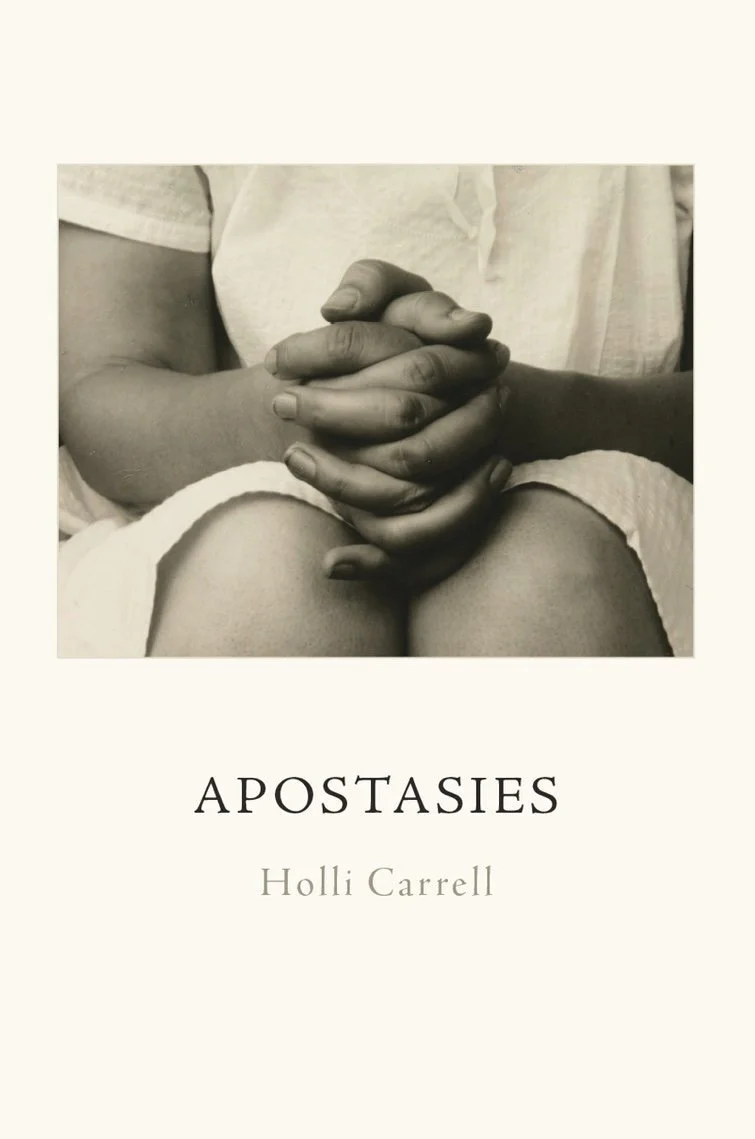
Holli Carrell’s debut poetry collection Apostasies explores Mormon girlhood, the American West, matriarchal lineage, indoctrination, estrangement, and the lingering ramifications of being raised within a repressive and patriarchal American religious ideology. Interweaving prose, documentary poems, translations, erasures, and spare, imagistic lyrics, Apostasies aims to recover and reclaim the body by its own definition. Casting her experience within the broader narrative of Mormonism, Carrell unpacks the fraught history of gender and polygamy in nineteenth-century Mormonism, exposing the sexual predation and grooming tactics used by Joseph Smith—Mormonism’s founder—on his thirty-three “wives,” many of whom were fourteen to eighteen years old at the time of their marriage. Courageous and defiant, the poems in Apostasies ultimately celebrate doubt and disobedience; they challenge oppressive constructions of womanhood and cisnormativity, in particular rejecting motherhood, “obedience,” and religious traditions that vilify independent thought and bodily autonomy.
PRAISE
“I am so tired of men/ calling their hunger God // their greed: / Commandment— / but this is an American story after all.” Holli Carrell’s pulsating first poetry collection, Apostasies, lifts the veil on growing up Mormon in the United States to expose the seeded brutalities and indoctrinations from organized belief structures that stint and oppress the very fibers of selfhood, girlhood, womanhood, and nonbinary existence. Apostasies boldly interrogates a life under righteous surveillance, under siege by holiness and flockness, and what religious control cultivates in the interior. Carrell’s intimate and experiential poems deconstruct the “myth and figment” of the “American story” of the LDS Church with both a scalpel and an axe—this book is a reckoning.”
Felicia Zamora, Author of Interstitial Archaeology
Holli Carrell’s Apostasies is a fierce investigation of a woman’s life in and out of the Mormon church. The formal play—erasures, translations, interviews, an extended lyric essay—give expression to worlds that are too often kept secret, unnameable, impenetrable to outsiders. The speaker in these poems is someone who, to keep herself safe as a child, mastered the art of hiding; here she steps out of those shadows and sings her protests against “dangerous truths,” against “numbness, obliteration.” These protests are filled with courage, lyric beauty, and a hard-won appreciation for what she calls a “right to desire.”
Catherine Barnett, Author of Solutions for the Problem of Bodies in Space
Turning a critical eye toward western religion, Holli Carrell’s Apostasies examines how restrictive practices and doctrines often share the same face with patriarchy. Through the specific lens of Mormonism, and the atrocious crimes of its founder, Joseph Smith, Carrell demonstrates how these problematic teachings villainize the agency of women by creating a God preoccupied with punishment. In the face of such chastisement, Carrell rips off God’s mask and shows us the man who “rips the door / off its hinges and hovers / over my bed,” a man like Joseph Smith who systematically weaponizes religion for his own perverted and narcissistic desires. In her signature, quiet rage, Carrell holds the mask in her hand and names it what it is, and in doing so, claims, “I have lived and I will die; / I do not need a god.”
Taylor Byas, Author of Resting Bitch Face
Holli Carrell’s Apostasies is, as the title promises, a book of refusals rooted in the fierce interrogation of the indoctrinations, disguises, and violences of the LDS Church, each refusal relentlessly enacted. The first: that of the religious footnote, Carrell’s speaker presenting “the biblical story” as lived, tangible reality. Also: the refusal of inheritance, of blind faith, of the perpetuation of harm. Lot’s wife is punished for looking, but Carrell’s speaker looks harder, accountable as much to her own girlhood, body, and self-authored desire as to the long line of women who have suffered the ravages of the Church. Poem after poem, we are shown that to document is to offer an indictment. To say, here are the facts, history, experience, and reflection extended with tender and necessary deliberation as well as brute force. This book is truly an achievement: a mixture of poetry and prose, linguistically and formally innovative, deeply researched, critical, narrative, highly imagistic, and deserving of a place in every classroom.
Susan L. Leary, Author of More Flowers
Apostasies reads like a history lesson wrapped in a memory play. Salt Lake City native Holli Carrell’s ambitious collection presents a thorough, personal study of structural gender violence in the Mormon church. Carrell alternates between a dialogic interrogation of the structural misogyny and predation within the Mormon movement and searingly specific memories of moments where that ideology was branded onto her body. Throughout the collection, Carrell positions the reader at just the right angle to peer through a window into the problem which lacks not merely a name, but a voice with which to speak it. The result is an accomplished piece of feminist scholarship—Apostasies is the single best piece of literature I read, from any genre, in 2025.
Pella Felton, The Literary Underground